© Museu Comarcal de l'Urgell-Tàrrega
Omeka ID 1225
Pla de les Tenalles
Protohistory and Iberian world

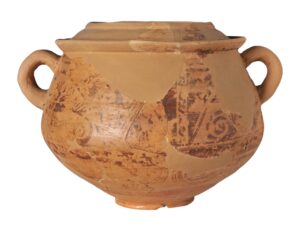
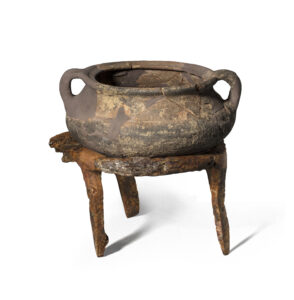
small pot

MCUT 3070

Object type
olla
Production date
-300 / -100
Fabric
common Iberian pottery
Museum
Museu Comarcal de l'Urgell-Tàrrega
Culture
Protohistory and Iberian world
Discovery location
Pla de les Tenalles
Materials
pottery
Township
Granyanella (Europa, Espanya, Catalunya, Lleida, La Segarra)
Technique
handmade
Where is it?
Exposició permanent
Dimensions
106 x 70 x 102 mm
Description
Small pot, with the characteristic ‘S' profile of the body, everted rim and flat base. The decoration consists of a horizontal strip with a series of impressed motifs in the form of elongated oblique spikes at the height of the shoulder of the piece. It has an outer surface that would have been polished initially but it is very worn in the lower half of the pot, most likely due to the use. It is surely a piece of kitchenware intended for cooking or food processing. The pottery is hand made with a coarse fabric with plentiful mineral temper, which makes it particularly suitable to resist the action of fire. Precisely in the area of ​​contact with the fire and the hearth is where this piece shows obvious erosion and wear. Pots of this type with the same decoration are very common in all the northern Iberian territories, from the Languedoc to Castellón. Further south they disappear as the ceramic kitchenware is also coarse but always made on the wheel. This piece comes from the Iberian village of Pla de les Tenalles de la Mora, Square 76, Stratum II (excavations by Pedro Villalba), with an imprecise date that should be between the fourth century BC and early second century BC.