© Museu d'Arqueologia de Catalunya - Barcelona
Omeka ID 2264
Olèrdola
Protohistory

rod mould

MAC OLE-00444

Object type
mold
Production date
-400 / -100
Fabric
-
Museum
Museu d'Arqueologia de Catalunya - Barcelona
Culture
Protohistory
Discovery location
Olèrdola. Entrada recinte (sector 01)
Materials
limestone
Township
Olèrdola (Europa, Espanya, Catalunya, Barcelona, Alt Penedès)
Technique
carving, polishing
Where is it?
Reserves
Dimensions
54 x 172 x 172 mm
Description
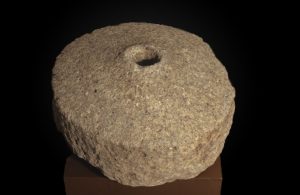
Fragment of a valve of a mould for casting bronze rods. Made of greyish limestone, it displays signs of exposure to incandescent metal. The conservation of the valve is not very good. It was recovered in a medieval level (1987 excavation, Sector 01), although this does not detract from its protohistoric attribution, since these pieces are not typical of the Middle Ages. The ventral face presents the matrices of five grooves arranged longitudinally although perhaps there were more. The width of these matrices oscillates around 10 mm and the separation between them varies between 15 and 20 mm. The fact that the mould is incomplete does not allow us to say if this is where the metal was poured or if it is the lower part of the mould. The complete mould consisted of two valves and was used unilaterally. This was the most popular type in the Bronze and Iron Ages, as it produced rods that could easily be made into many types of objects: needles, fibulae, bracelets, etc. The rods were semi-manufactured elements of the raw materials that were transformed later. That explains their wide distribution. While it is true that in Carretelà (Aitona, Segría), for example, those moulds existed during the late Bronze Age (Ribes 2002, 151), the present example resembles more closely the moulds documented in Ullastret that are dated in about the fourth and third centuries BC (Rovira 1999, 230-232).