© Museu Comarcal de l'Urgell-Tàrrega
Omeka ID 1257
Balma del Clotar de Vall-llebrera
Prehistory

hemispherical bowl

MCUT 2612

Object type
bowl
Production date
-4000 / -3000
Fabric
Eneolithic pottery
Museum
Museu Comarcal de l'Urgell-Tàrrega
Culture
Prehistory
Discovery location
Balma del Clotar de Vall-llebrera
Materials
-
Township
Artesa de Segre (Europa, Espanya, Catalunya, Lleida, La Noguera)
Technique
handmade
Where is it?
Exposició permanent
Dimensions
166 x 146 mm
Description
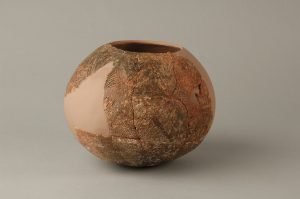
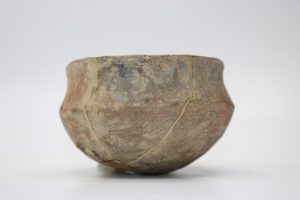
Hemispherical hand-made ceramic bowl with thin walls, convex-concave base, and slightly closed rim topped by a thin, pointed lip. The well-fired fabric is brown, homogenous and refined, with fine quartz and mica temper. The outer surface, light brown with some small black spots, is spatulate and the internal brown surface is polished. As decoration, at the top of the shoulder of the preserved part of the vessel, near the edge, three pointed nipples are aligned parallel to the lip. Hemispherical bowls with small nipples near the lip, along with other types of plastic elements such as lugs or embossed pads are very common among ceramic assemblages of late Neolithic-Chalcolithic groups (second half of the 3rd and 4th millennium cal. BC) both in southern France and Catalonia. The various ceramic fragments of this vessel were found and collected by Sr. Antoni Bellart in a small cave in Clotar de Vall-llebrera (Artesa de Segre, Noguera), and he donated them to the Regional Museum of Urgell (GALLART, RIBES 2001).