© Museu de Badalona
Omeka ID 1896
Ciutat romana de Baetulo. Sant Josep i de Rosés
Roman world

signet ring

MB 3298

Object type
ring
Production date
1 / 100
Fabric
-
Museum
Museu de Badalona
Culture
Roman world
Discovery location
Ciutat romana de Baetulo. Sant Josep i de Rosés
Materials
gold
Township
Badalona (Europa, Espanya, Catalunya, Barcelona, Barcelonès)
Technique
casting, engraving
Where is it?
Exposició permanent
Dimensions
1,7 x 1,5 cm
Description
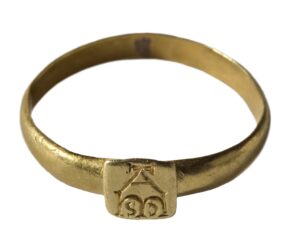
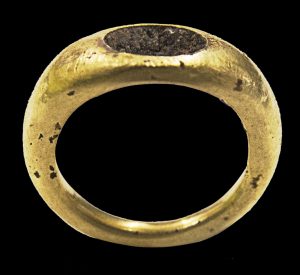
Gold ring worked with the casting technique, which shows an engraving, very well achieved stylistically, of an imperial eagle looking to the left, in a resting attitude and with its beak open. The bird's legs rest on what has traditionally been described as Jupiter's bow, although it would surely be more correct to consider it Jupiter's thunderbolt, a more typical attribute of the father of the gods. It is a very common iconography in Roman times, which during the Republic was associated with Jupiter and in imperial times it was equated with the emperor and the power of the Roman Empire. The internal diameter of the ring, detailed above, is very small. This should make us think of two possibilities: if it was designed to be worn, it could only have been worn by a child or it could have been used to decorate a sculpture; but it is most likely that it was simply worn tied around the neck as a pendant, since the general characteristics of the piece make us think that the owner must have been an adult man who would most likely use it as a seal for the certification of documents. The piece was found in the context of a hoard, in a hole made in the soil and covered by a rectangular stone. The hole had a filling with a lot of ashes, which led the excavators to think that it could be the remains of a small wooden box or some other wrapping of vegetable origin.